What If You Were Alone?
LettersWay started as a family game: a group of people around a hex board, letters and questions in front of them, each one trying to prove they know more than the rest (or at least that they know the answer before their twelve-year-old nephew).
It was simple. A question, a letter, an answer, then someone celebrating, someone objecting to the question, and someone insisting they knew it, "it was on the tip of my tongue."
That is how the game began, and that is how it was supposed to stay.
Then a very small problem appeared, because of a very small question:
What if you were alone?
No family around you, no rival racing you to the answer, nobody you can accuse of cheating. In front of you, more than 2,000 questions and a whole bank of letters. What would you do with them?
At first we thought the answer was obvious: show the questions one after another and count the right ones.
We did that.
Then we tried it.
Then we shut it down the same day.
It turns out that a person on their own does not need a sad version of the group quiz. They need a reason to keep going. They need to know where they are, where they are heading, and whether today they are actually better than yesterday.
In short, they did not need an opponent.
They needed a path.
From a game to a curriculum
When you start building a game, it is easy to drift toward the fun things: colours, points, effects, levels, badges, and the stars that explode on the screen when you get one right (because apparently none of us can finish anything today without the screen congratulating us).
We decided to flip the equation.
Curriculum first, game second.
So every world of LettersWay became a course, every difficulty level a section, every category a unit, and every lesson roughly four facts you can learn in four minutes.
You meet the fact first, then you pick it, then you match it, and at the end we take off the little training wheels and ask you to write it from memory.
If you can recall three out of four, you move on.
But here another problem showed up.
Who says the fact you answered today will still be with you tomorrow?
Why do we forget what we know?
Have you ever read a wonderful book, and a month later someone asked you about it, and all you could remember was the colour of the cover?
I have.
The problem is that recognising a fact is not the same as retrieving it. You can look at the answer and say "of course, I knew that," but try pulling it out of your head without seeing it, and that is where the trouble starts.
So what you learn now comes back to you after a day, then three days, then seven, then fourteen, then thirty.
A fact we never try to reach loses, little by little, the road that leads to it.
And that made us wonder: what if memorising itself could be more fun?
We picked twenty Muslim scientists and decided to build a completely different way of remembering them.
A memory palace, rooms of five people each, every name turned into a picture, every achievement into a gesture you can make with one hand, every century into a shape, and for each room a rhymed chant that helps you bring back what is in it.
And we made ourselves a clear promise:
if at the end of the path you cannot name 18 of the 20 from memory, the experiment did not work.
Everything was going more or less as we expected.
Until we discovered we were looking for the wrong problem.
The problem was never knowledge
We tried the game on adults.
I mean the generation that used to know the phone numbers of their friends and relatives by heart, the home number, their father's office, probably the corner shop too, before the smartphone arrived and decided our memory had more important things to do.
We asked easy questions.
And people knew the answers.
But they were... slow.
We ask about a capital someone has known since fourth grade, and they go quiet for a moment, look up as if the answer were written on the ceiling, and say:
"Wait... I know this!"
And three seconds later, out it comes.
The fact had not disappeared.
It was there.
But the road to it had grown longer.
Then we noticed something even more interesting.
There are things we use every day whose Arabic names have started to vanish from our mouths. The tablet is a "tablet," the small camera a "webcam," the editing strip a "timeline."
We know the thing. We use it. We may have owned it for years.
But we have lost its name.
So we reviewed 180 questions by hand, one by one. We kept 76 as they were, edited 65, and replaced 39 entirely.
Why?
Because some questions were perfectly correct on paper, but no longer correct inside people's heads.
A term may have a proper Arabic name nobody uses, or a name that starts with a different letter depending on whom you ask, and in a game built on letters, those small details become a big problem.
And that is where the whole question changed.
What if our problem is not that we do not know?
What if we do know... but can no longer easily reach what we know?
On the tip of my tongue
There is a big difference between two sentences:
"I don't know."
And:
"I know it... it's on the tip of my tongue!"
The first means you need to learn something new.
The second means the fact is already there, but the path to it is being buried.
That was the idea that changed the project for us.
We no longer wanted only to measure how much you know, but where the roads inside your memory have become less clear.
So we built a short experiment that takes no more than three minutes.
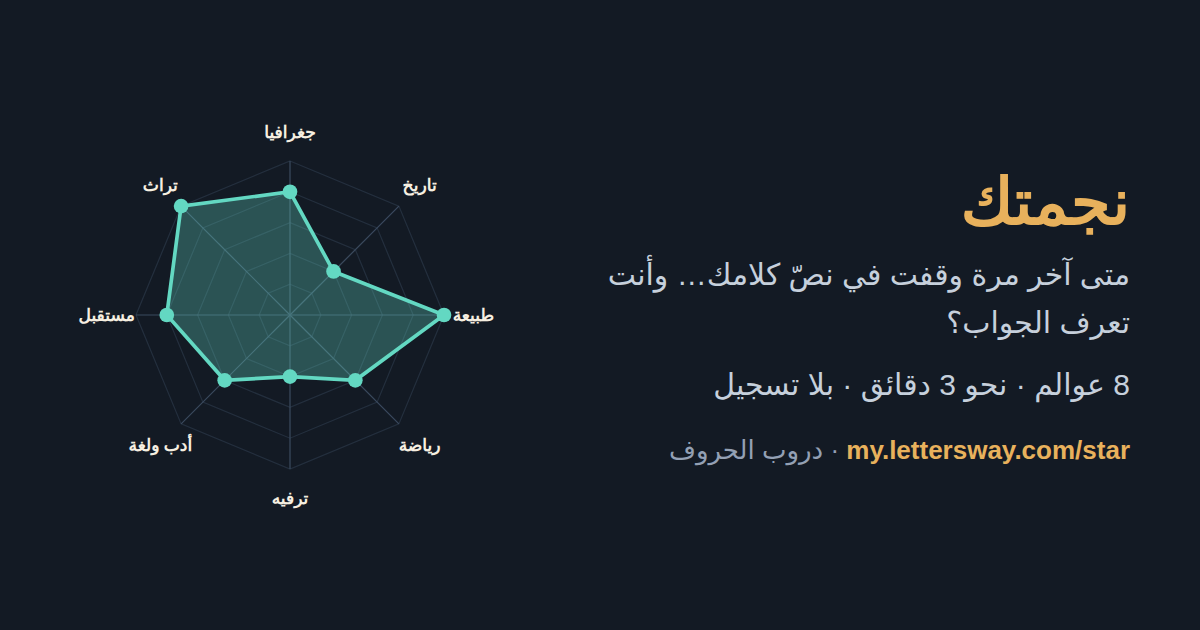
Eight worlds. In each one you start with a medium question, then climb until you stumble.
And when you get one wrong, we do not rush to show you the answer.
We ask first:
was it on the tip of your tongue?
Because that small question tells us far more than "right" or "wrong."
Then your result appears as an eight-pointed star. Each point is a world, its length is how deep you went, and its transparency shows how much of the road has been buried.
And if you knew nothing?
You get zero.
Yes, a real zero.
No participation star for trying, no ten points for pressing the button nicely.
Then reality started ruining our beautiful plans
One thing I have learned from projects is that an idea looks brilliant while it is still inside your head.
Then the user shows up.
At first we drew a full skill tree for every world. It was beautiful and tempting, and then we realised we were building an entire city before checking whether anyone wanted to live in it.
So we hid it.
One experiment proves one hypothesis first.
Then we discovered the first lesson was far too easy for adults. Words like "ear" and "penguin" will not make a grown-up feel they came to test their memory; they might suspect we got their age wrong.
So we added "place me": a small set of questions that adapts to your level and skips what you already know.
Then came the review problem.
We were asking you to come back after exactly twenty-four hours. Study at nine in the evening, open the game the next morning, and find nothing waiting.
Mathematically, the system was right.
Humanly, the system was stupid.
So we moved the due time to four in the morning of the next day.
Then there were questions that shifted inside the curriculum and took the player's progress with them, so we gave every lesson a fingerprint tied to its content, not its position.
We had nine worlds, then found that one of them did not deserve to be a world at all. So we redistributed 381 questions to where they naturally belong.
Then we noticed that answering took two taps.
Why two, when one is enough?
Now a correct answer turns green and moves on by itself, and a wrong one asks you about the "erosion" and carries on.
Even sharing, we discovered we had been thinking about the wrong way. A pretty card you can download does not mean anyone will share it. People share links and words long before they think about saving an image, finding it, and sending it.
And the funniest part of all: the text itself became an experiment.
We write two versions of the first screen. Half the people see one, half see the other.
Then we let the numbers settle the argument for us.
(Which is very useful when everyone is convinced their version is the prettier one.)
What are we actually trying to save?
The project began with a simple question:
what does a LettersWay player do when they are alone?
And we ended up in front of a completely different one:
what happens when the basics we have known since childhood start to disappear?
Maybe we have not lost the knowledge itself.
Maybe we have only lost the ability to summon it quickly.
And maybe there are Arabic words that were once natural in our mouths, then the sand covered them a little, until the road to them grew harder, and then we stopped using it altogether.
Memory is like a path in the desert.
It is not enough to walk it once and plant a sign that says "I passed through here."
Every time you walk it, it gets clearer.
And every day you leave it, the wind puts some of the sand back.
That, perhaps, is what we are trying to do with LettersWay.
We are not trying to fill your head with facts so much as reopen the roads to the things that are already in it.
So, what if you were alone?
This time, you might be in exactly the right place.
Three minutes may be all it takes to find out which paths in your memory are still clear... and which ones the sand has started to cover.